RF & Microwave
Solid-state power amplifiers from 10 to 150 W covering 900 to 2700 MHz, each running from a single supply with built-in VSWR protection and RS-485 monitoring.
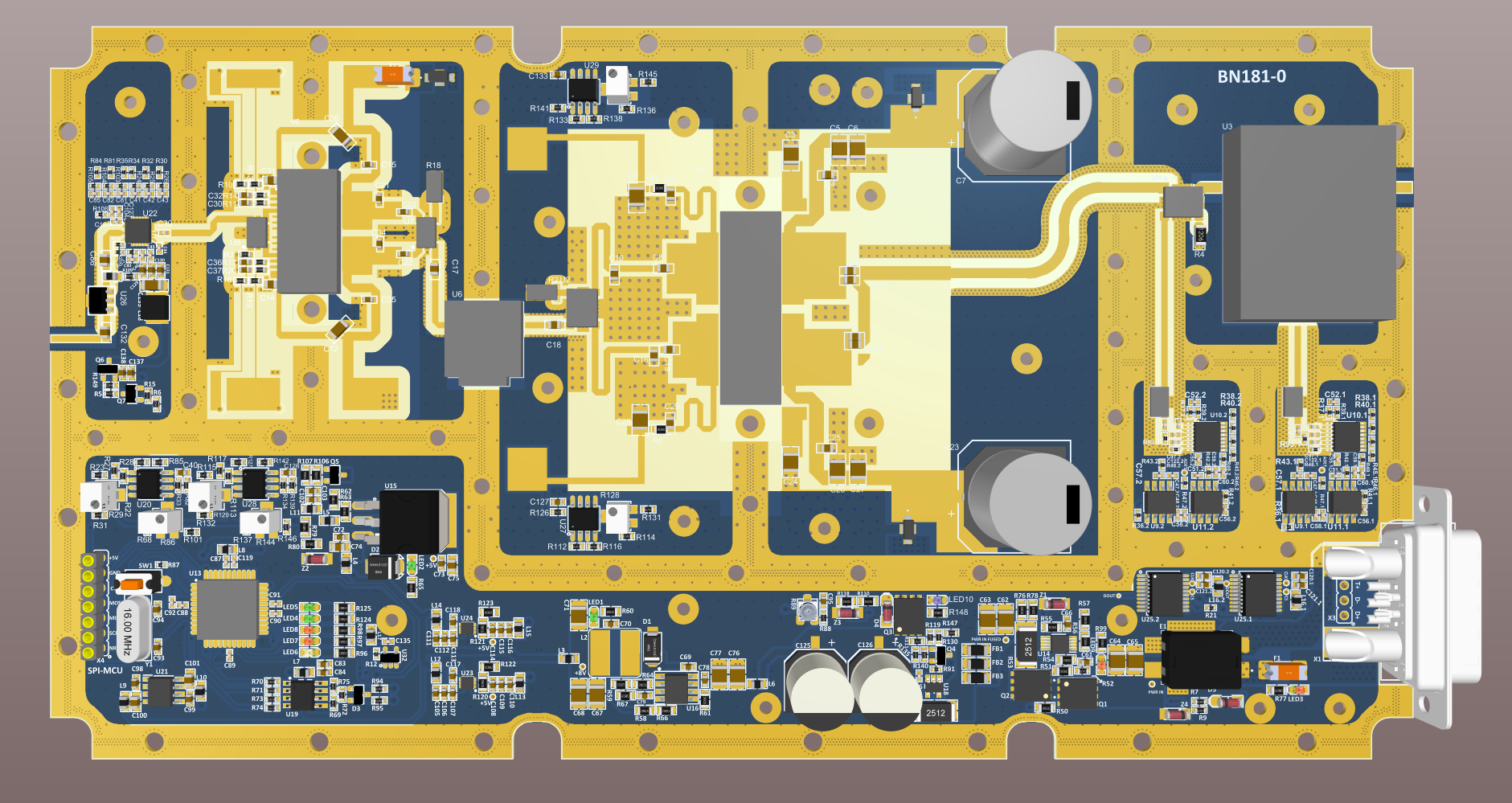
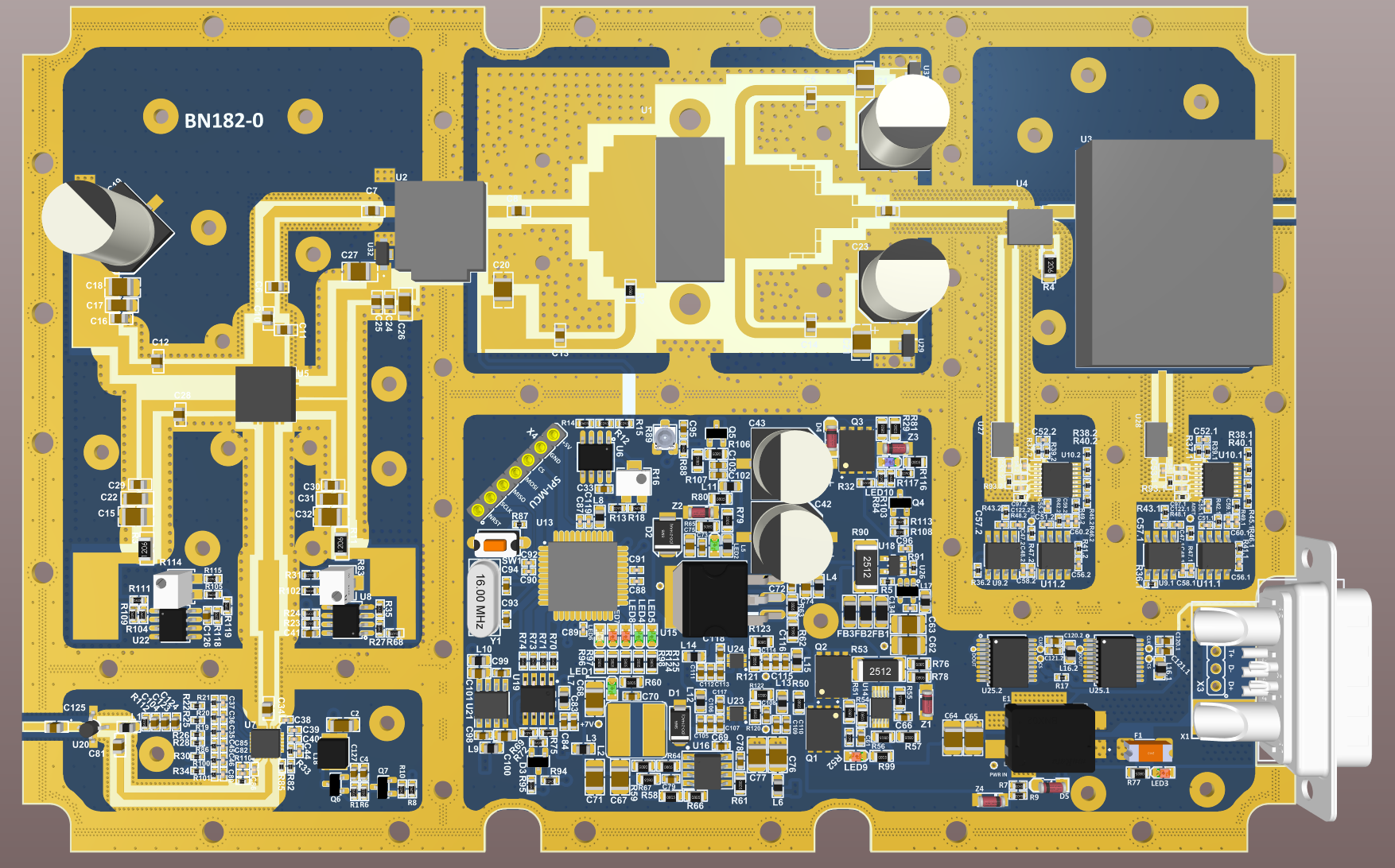
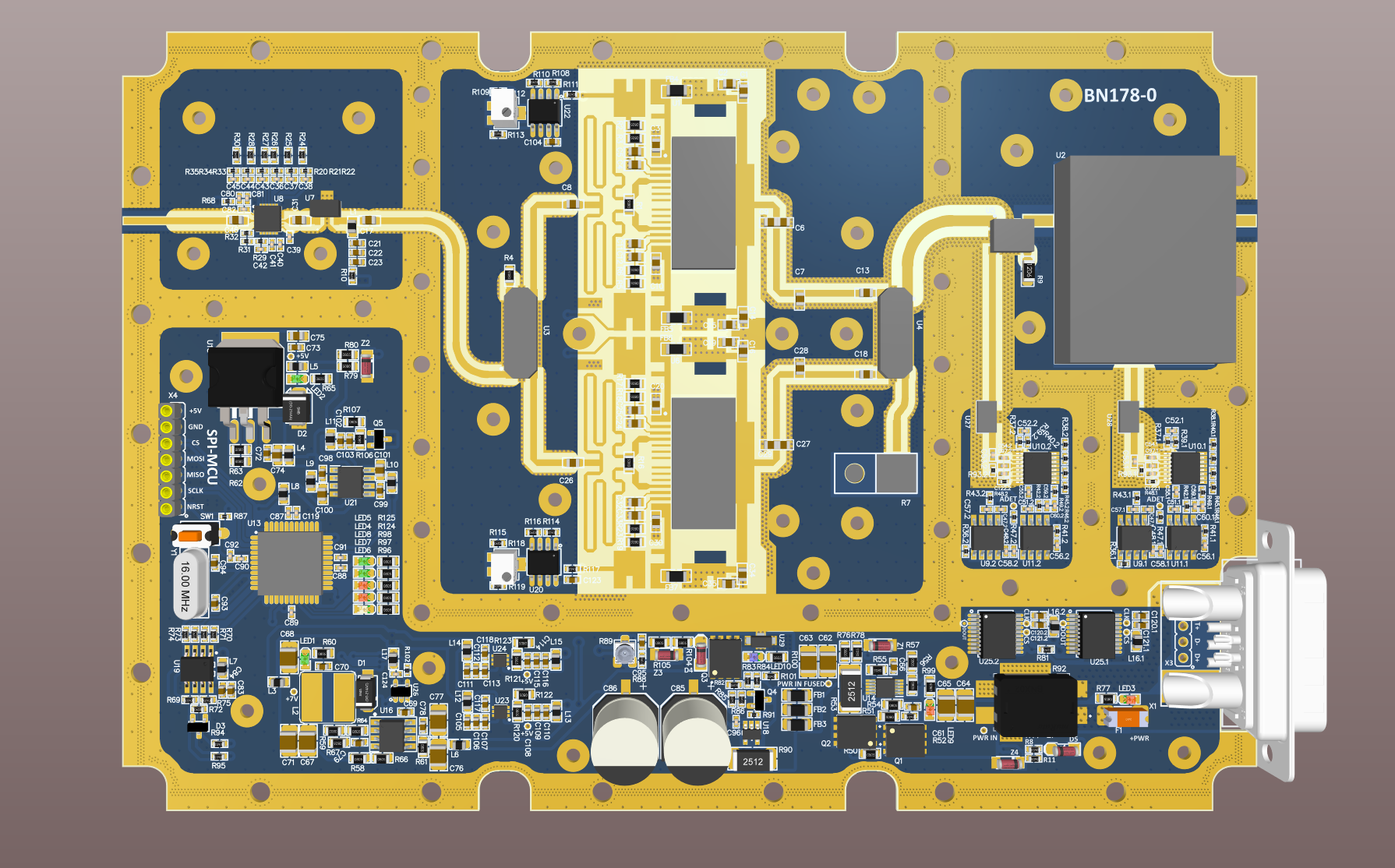
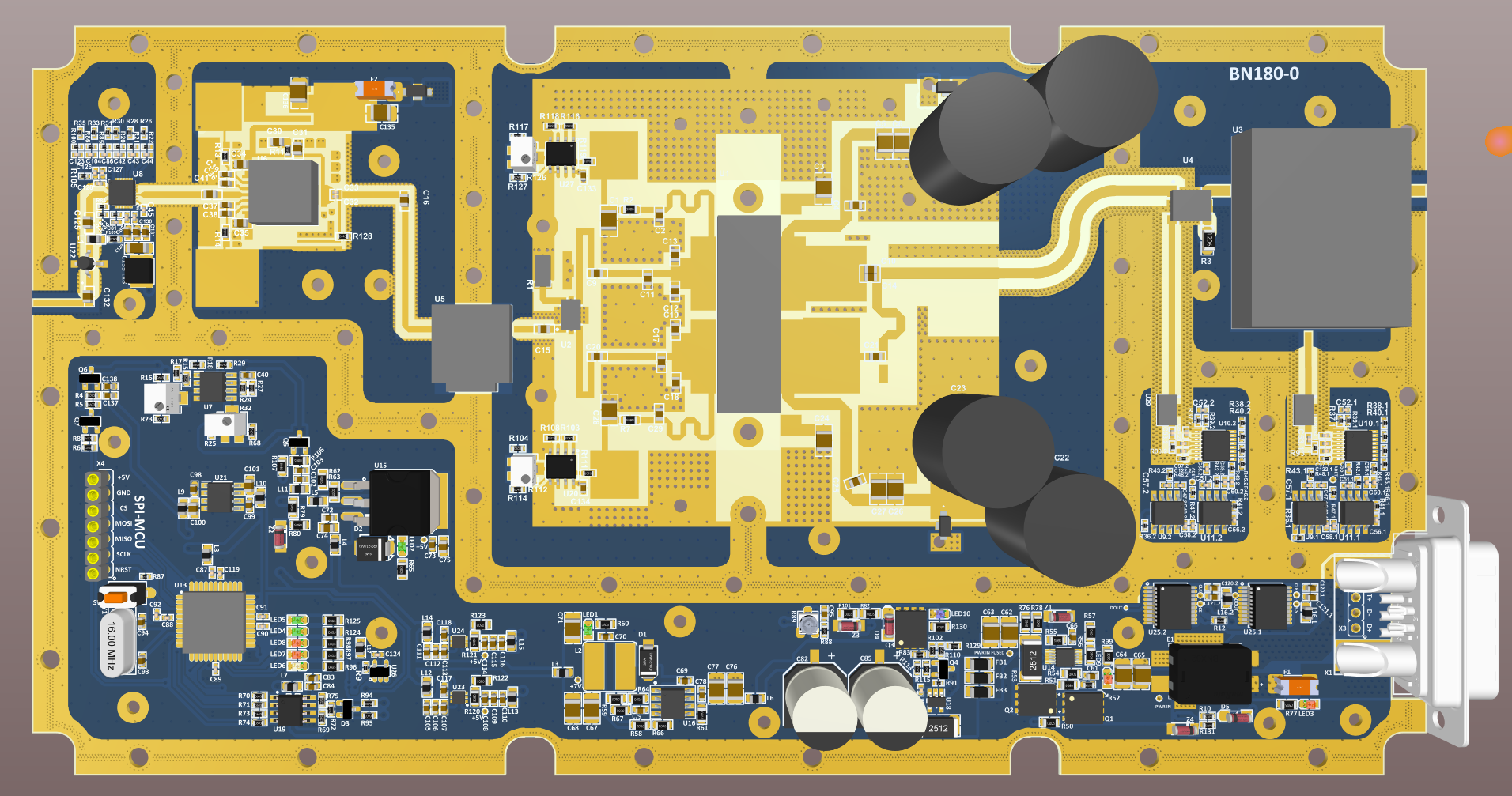
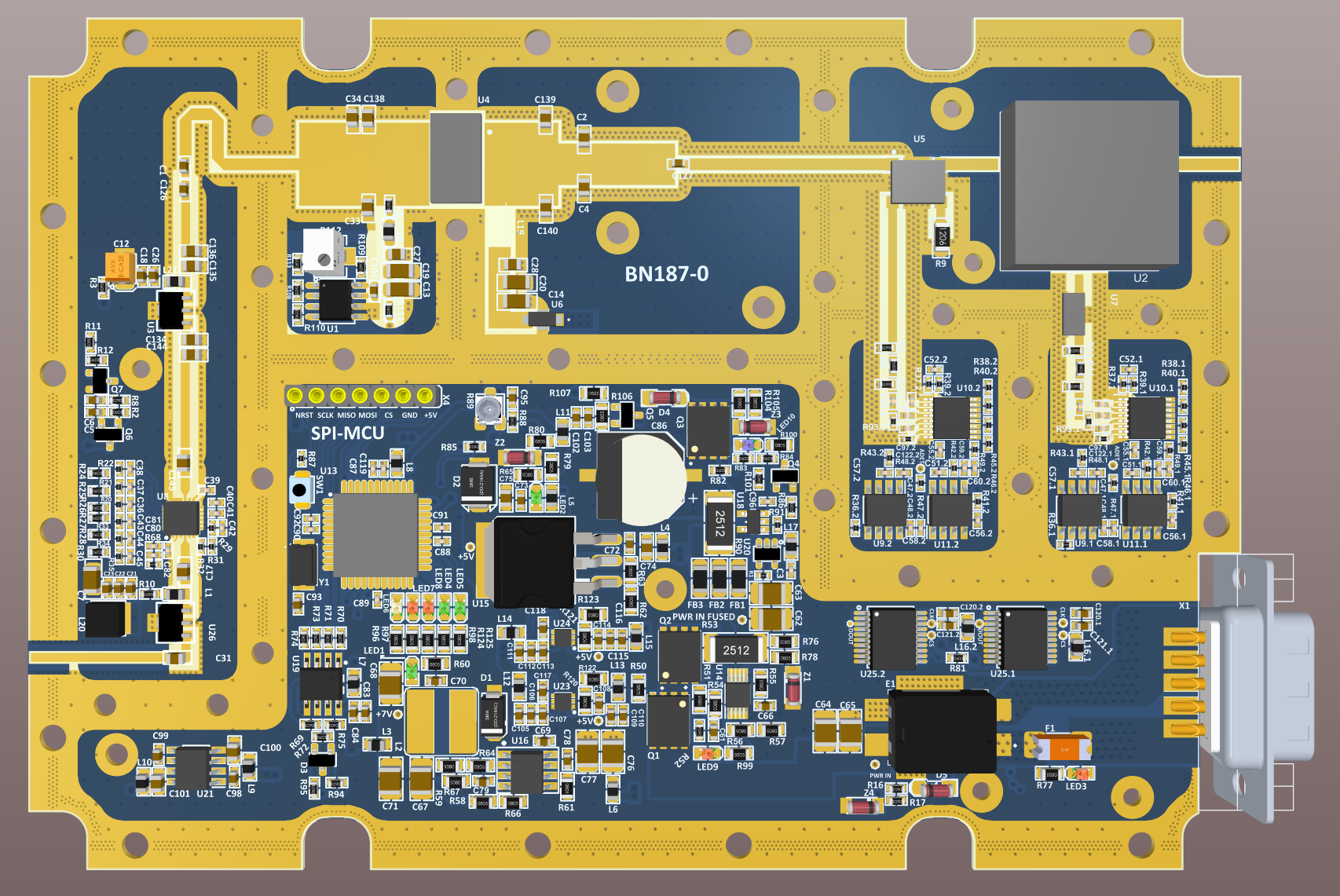
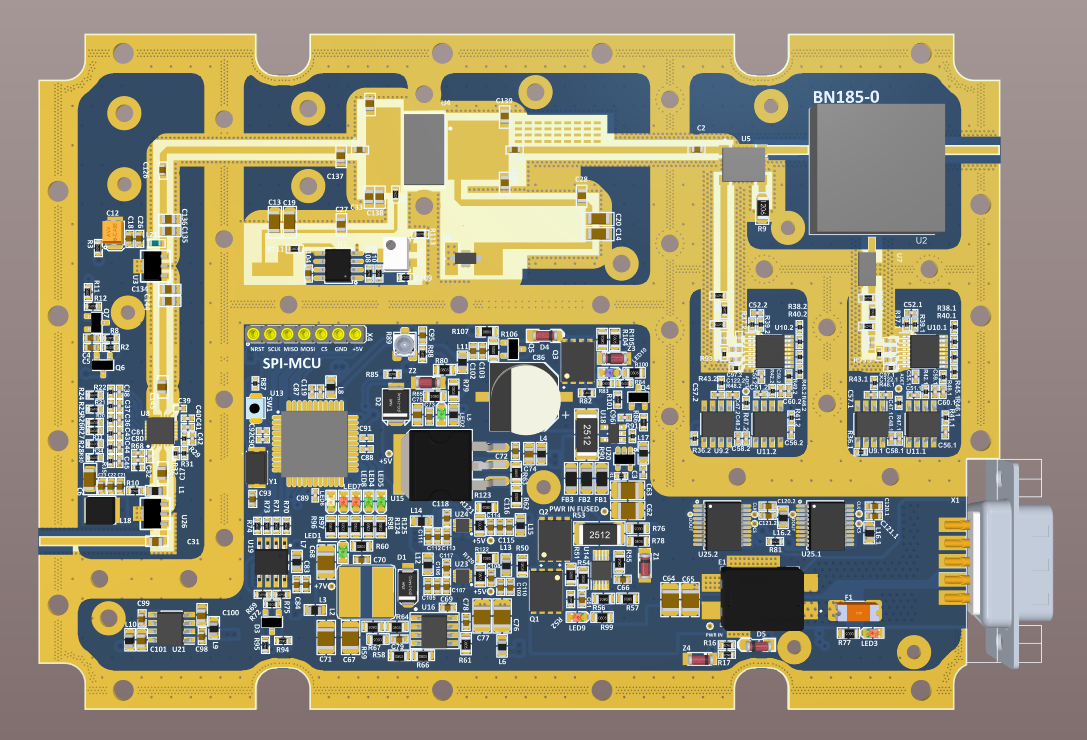
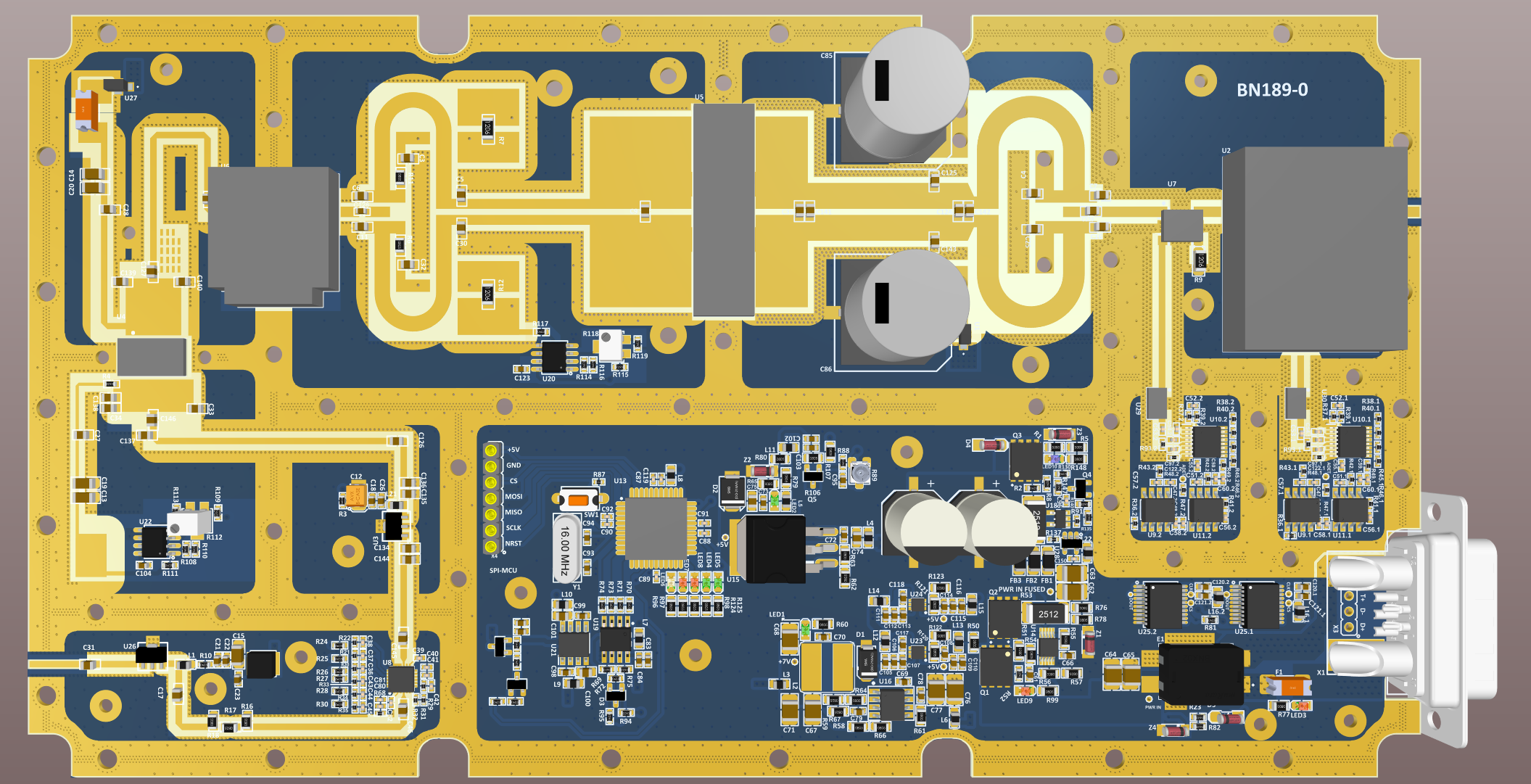
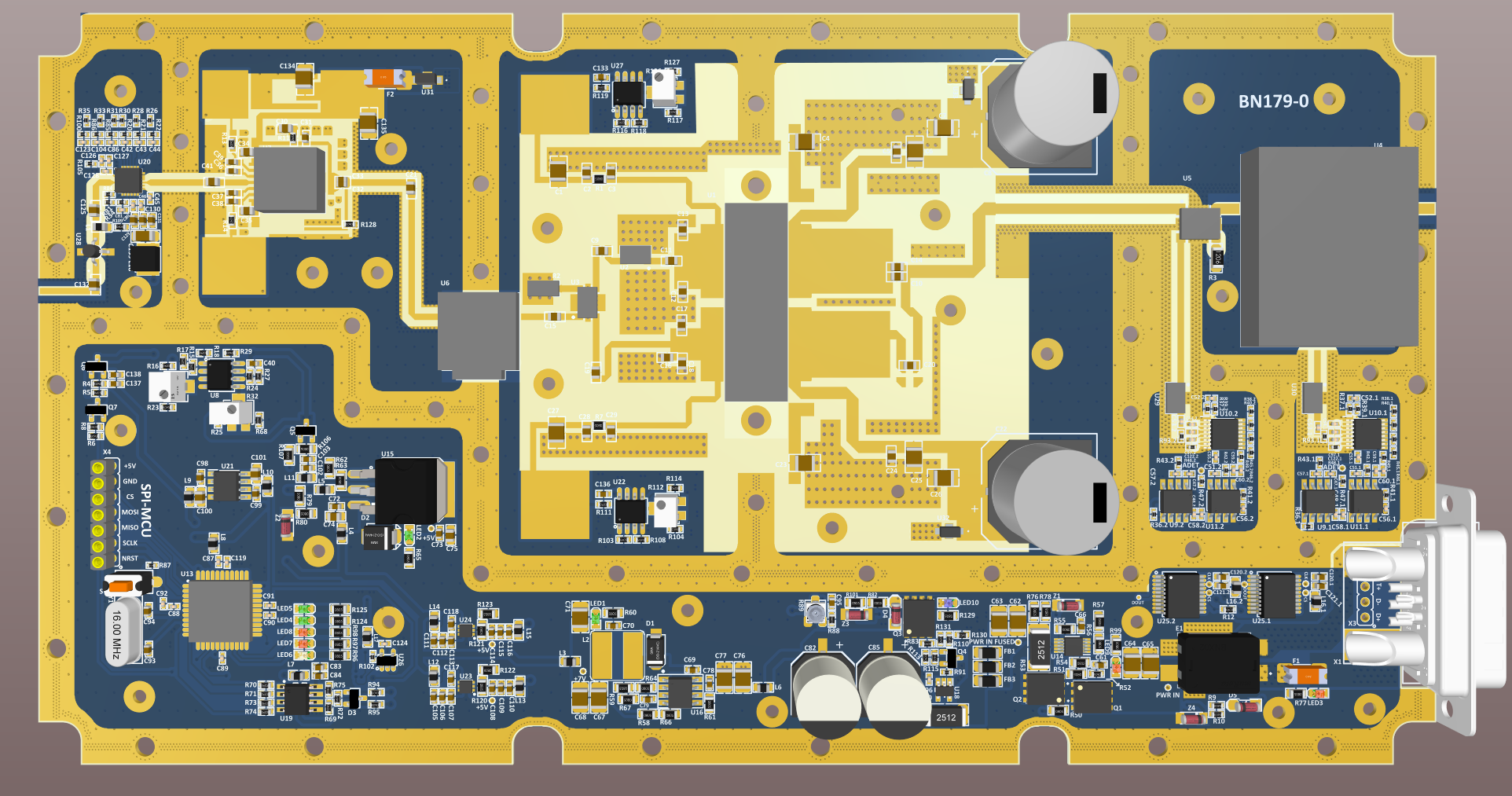
Solid-state RF power amplifiers, 900 to 2700 MHz
Every SL-SPA amplifier is a complete power stage on one board. A single DC supply feeds a variable attenuator, a pre-amplifier, a driver and the final stage, and a dual-directional coupler at the output measures forward and reflected power. An on-board supervisor uses those readings, with supply voltage, current and temperature, to protect the output stage against high VSWR, open and short-circuit loads, over-current and reverse polarity.
The range covers the cellular bands at 900, 1800, 2100 and 2600 MHz, L-band from 1200 to 1400 MHz and the 2.45 GHz ISM band, from 10 W to 150 W. Every board is rated for 100 % duty-cycle CW operation at full output and reports its status over RS-485.
Compare the range
| Part | Band | Rated output | Gain | P1dB | Supply | Typical use |
|---|---|---|---|---|---|---|
| SL-SPA-0950-50 | 900–1000 MHz | 50 W | 45 dB | 40 dBm | +28 V | Cellular base stations, repeaters |
| SL-SPA-1300-100 | 1200–1400 MHz | 100 W | 57 dB | 44 dBm | +32 V | L-band transmission, radar support |
| SL-SPA-1850-10 | 1800–1900 MHz | 10 W | 44 dB | 37 dBm | +28 V | Base stations, driver stage |
| SL-SPA-1850-20 | 1800–1900 MHz | 20 W | 43 dB | 38 dBm | +32 V | Base stations, driver stage |
| SL-SPA-1850-100 | 1800–1900 MHz | 100 W | 54 dB | 44 dBm | +32 V | Cellular base stations, repeaters |
| SL-SPA-2150-100 | 2100–2200 MHz | 100 W | 54 dB | 44 dBm | +30 V | Cellular base stations, repeaters |
| SL-SPA-2450-150 | 2400–2500 MHz | 150 W | 57 dB | 46 dBm | +32 V | 2.45 GHz ISM, RF heating |
| SL-SPA-2650-100 | 2600–2700 MHz | 100 W | 52 dB | 44 dBm | +32 V | Cellular base stations, repeaters |
Rated output is saturated CW power. Figures are typical values from the preliminary datasheets.
How to choose an RF power amplifier
Start from the band
Each amplifier is matched to one band. Pick the part whose range covers your carrier with margin at both edges, and talk to us if your band falls between two of them.
Size power for your signal
The rated figure is saturated CW output, the right number for RF heating, energy transfer and other constant-envelope work. Modulated signals need linear headroom, so plan around P1dB and back off from it.
Plan the cooling
The boards have no cooling of their own. Bolt them to a heatsink or cold plate, or order the -H version supplied with a matched heatsink assembly.
Use the telemetry
Forward and reverse power, supply voltage, current and temperature are readable over RS-485, so a host can log output power and spot a failing cable or antenna before it trips the protection.
Frequently asked questions
What is the difference between rated output power and P1dB?
Rated output power is the saturated continuous-wave power the amplifier delivers when fully driven. P1dB is the output level at which gain has fallen 1 dB below its small-signal value, the practical ceiling for linear operation. On these amplifiers P1dB sits several dB below the saturated rating, so use the saturated figure for CW work and P1dB for modulated signals.
Can the amplifiers run continuously at full power?
Yes. Every board in the range is rated for 100 % duty-cycle CW operation at full output, provided it is mounted on an adequate heatsink.
What happens if the load is disconnected?
The output coupler measures reflected power continuously, and the supervisor reduces or removes drive when VSWR passes the trip point, then flags the fault. Protection is not instantaneous, so terminate the output before applying drive and never hot-plug an RF connector on a running amplifier.
How are the amplifiers controlled?
Over a half-duplex, two-wire RS-485 bus that several amplifiers can share. A host sets the output level and protection thresholds, enables the amplifier, clears faults and reads forward power, reverse power, voltage, current, temperature and a status word.
Can you supply a different band or power level?
Often, yes. The range shares one design, so tell us the band, power and interface you need and an engineer will tell you what is feasible.
Need another band or power level?
Tell us the frequency, power and interface you need. The first consultation is free.